In workshops and heavy industry, vertical lathes (vertical turning lathes, VTLs) are often seen as large, stable, and powerful machines. While horizontal lathes are common, vertical lathes play an irreplaceable role in processing heavy, large-diameter parts. This blog explains their structure, advantages, applications, and why factories rely on them.
What Is a Vertical Lathe?
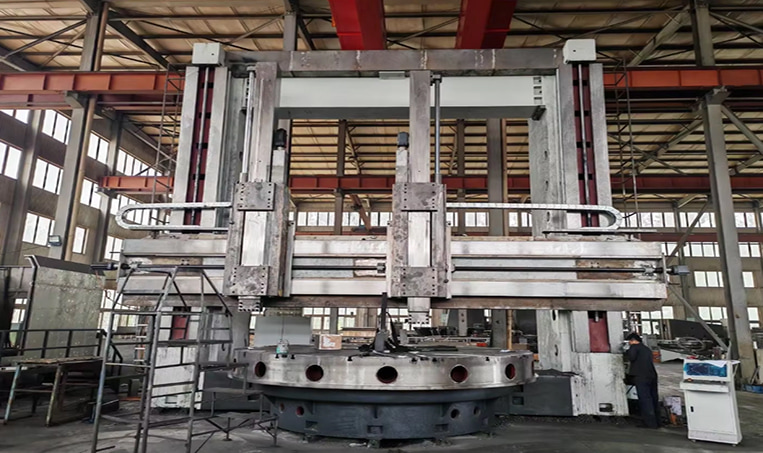
Unlike horizontal lathes, a vertical lathe has a vertical spindle. The workpiece is mounted horizontally on a rotating table, like a turntable. This design makes it extremely suitable for parts that are large in diameter, short in length, and heavy in weight.
Key Advantages of Vertical Lathes
- Excellent stability for heavy workpieces
Heavy parts rest on the table by gravity. The heavier the workpiece, the more stable the cutting becomes, avoiding bending or vibration common in horizontal lathes.
- Ideal for large-diameter parts
Flanges, gears, wheels, and discs that are too big for horizontal lathes can be easily processed on vertical lathes.
- High machining accuracy
The vertical structure reduces deformation caused by gravity and heat. Roundness, flatness, and dimensional precision are more stable.
- Safe and convenient loading
Parts are loaded and unloaded from above with cranes. This is much safer for large, heavy components.
- Strong multi-process capability
CNC vertical lathes can complete outer diameter, inner hole, end face, grooving, chamfering, and curved surface machining in one clamping.
Typical Applications
Vertical lathes are widely used in these industries:
- Wind power: hubs, bearing seats, flanges
- Engineering machinery: large gears, rotating chassis
- Automobile & EV: wheels, brake discs, large casings
- Energy & power: turbine parts, pump bodies, valves
- Shipbuilding & heavy industry: large discs, end covers, forgings
- Mold industry: large rotary molds
Modern Development Trends
- High automation: CNC systems, automatic tool changers
- Intelligent production: data monitoring, adaptive processing
- 5-axis capability: for complex curved surfaces
- Large-scale & high-rigidity: for super-large parts in heavy equipment
- Robot loading: unmanned and lights-out production
Conclusion
Vertical lathes are not better than horizontal lathes — they are specialized for different tasks. They shine in processing large, heavy, high-precision rotary parts.
With the rapid development of new energy, heavy industry, and intelligent manufacturing, vertical lathes will continue to be essential equipment in modern factories.