Choosing the right equipment for crusher feeding can significantly impact productivity, operating costs, and material handling efficiency. When comparing an excavator vs wheel loader, the best choice depends on material type, jobsite conditions, and crushing requirements. While wheel loaders excel at handling and transporting loose materials, excavators offer greater flexibility for digging and managing oversized rocks. This guide compares their advantages, limitations, and applications to help you choose the right crusher-feeding solution.
1.Quick Answer: Wheel Loader or Excavator for Crusher Feeding?
There is no single best machine for every crusher-feeding operation. A wheel loader is ideal for handling large volumes of loose material, moving stockpiles over short distances, and maintaining continuous crusher feeding. An excavator is better suited for digging raw material, handling oversized rocks, precise feeding, and working in challenging terrain. The right choice depends on material type, site layout, crusher feed opening, and production requirements. In many quarries, using a wheel loader and excavator together can improve overall productivity.
2.Key Takeaways
Wheel loaders excel at handling large material volumes and short-distance transportation.
Excavators are better suited for digging, rock handling, precise feeding, and challenging working conditions.
Equipment selection depends on material size, hardness, moisture content, and stockpile conditions.
Bucket capacity, travel distance, and crusher feeding capacity must be properly matched.
A hydraulic breaker enhances an excavator's ability to handle hard rock and oversized materials.
Combining both machines can improve material handling efficiency and optimize the overall crushing process.
3.What Determines the Best Crusher Feeder?
Choosing the best crusher feeder depends on several factors, including material characteristics, crusher specifications, jobsite conditions, and production targets. Understanding these factors helps operators select the right equipment, maintain consistent material flow, and improve overall crushing efficiency.
Material Type and Size
The type and size of material directly affect equipment selection. Loose aggregates, crushed stone, sand, and other bulk materials are generally easier to handle with a wheel loader. In contrast, large rocks, hard rock, ore, and oversized materials may require an excavator for digging, breaking, and controlled feeding. Material density, hardness, particle size, and stockpile conditions should also be considered. If oversized rocks cannot enter the crusher directly, pre-breaking or secondary processing may be necessary.
Crusher Capacity and Feed Opening
The crusher's hourly processing capacity and feed opening determine how much material can be delivered and what maximum material size is acceptable. Equipment bucket capacity should match the crusher's feeding requirements to maintain a steady material supply. Overloading may cause blockages, uneven feeding, and unnecessary equipment downtime, while insufficient feeding can reduce production efficiency.
Jobsite Layout and Material Distance
The distance between stockpiles and the crusher, available working space, turning radius, and ground conditions all influence equipment performance. Wheel loaders are suitable for short-distance material transportation, while excavators offer greater flexibility in confined or uneven working areas. Fixed and mobile crushing plants may also require different feeding arrangements.
Production Goals and Operating Costs
Daily production targets, operating cycles, fuel consumption, operator efficiency, maintenance requirements, and equipment downtime should all be evaluated. The best choice is not necessarily the machine with the largest bucket, but the one that delivers the required throughput at the lowest overall cost per ton.
4.Wheel Loader for Crusher Feeding: Advantages and Limitations
Why Wheel Loaders Work Well for Crusher Feeding
A wheel loader is a popular choice for crusher feeding because of its large bucket capacity, fast loading cycles, and efficient material handling. It can move substantial volumes of loose aggregates, crushed stone, and other bulk materials in a single pass, reducing the number of loading cycles required.
With good maneuverability and relatively fast travel speeds, wheel loaders can efficiently transport materials between stockpiles, hoppers, and crushers. Their ability to perform repeated loading and unloading tasks makes them particularly suitable for continuous feeding operations. In addition, their versatility allows operators to handle stockpile management, material transportation, and other on-site loading tasks with the same machine.
Limitations of Wheel Loaders
Despite these advantages, wheel loaders have limitations in certain crushing applications:
Limited excavation capability: They are less effective at digging large rocks embedded in the ground compared with excavators.
Oversized material handling: Handling extremely large or irregular rock blocks may require additional equipment or pre-breaking.
Feeding precision: Positioning materials accurately in elevated or complex feeding areas can be more challenging.
Restricted working conditions: Narrow spaces, uneven terrain, and complicated stockpiles may reduce maneuverability and operating efficiency.
When Should You Choose a Wheel Loader?
A wheel loader is generally the better choice when:
Loose materials in stockpiles need to be moved quickly.
The crusher requires continuous feeding with large material volumes.
The transportation distance between the stockpile and crusher is relatively short.
The quarry provides sufficient space for loading, turning, and material transportation.
One machine needs to handle multiple tasks, including loading, stockpile management, and on-site material handling.
When evaluating Wheel Loader vs. Excavator, a wheel loader is often the more practical option for high-volume material transportation and continuous crusher feeding, particularly in quarries with suitable ground conditions and sufficient operating space.
5.Excavator for Crusher Feeding: Advantages and Limitations
Why Excavators Are Suitable for Crusher Feeding
An excavator is a versatile machine for crusher feeding, particularly when raw materials need to be extracted directly from the ground or handled in challenging working conditions. Unlike wheel loaders, excavators use a boom, arm, and bucket to reach materials at different heights and positions, allowing operators to dig, lift, and feed rocks into crushers with greater control.
Their powerful digging capability makes them suitable for handling large rocks, uneven material piles, and irregularly shaped aggregates. With flexible working ranges, excavators can also position materials more precisely, helping maintain a consistent feed into the crusher.
For quarrying and mining applications, crawler excavators offer good traction and stability on soft, uneven, and rough terrain. Different excavator sizes can be selected according to material volume, digging requirements, and site conditions.
Another important advantage is their ability to perform pre-processing tasks. When equipped with a compatible hydraulic breaker, an excavator can break hard rock and oversized materials into smaller pieces before they enter the crusher. This makes an Excavator for Rock Breaking particularly useful in quarries where large rocks cannot be fed directly into crushing equipment.
Limitations of Excavators
Despite their versatility, excavators also have some limitations in crusher-feeding operations:
Lower transportation efficiency: Excavators are generally less efficient than wheel loaders for repeatedly moving large volumes of loose material over short distances.
Frequent repositioning: Moving between stockpiles and crushers may increase operating time and reduce feeding efficiency.
Equipment matching: Bucket capacity, machine operating weight, and crusher feed opening must be properly matched to avoid inefficient loading.
Additional equipment requirements: When an excavator handles digging, loading, transportation, and feeding alone, supplementary machinery may be needed to maintain continuous production.
When Should You Choose an Excavator?
An excavator is generally the better choice when:
Raw materials need to be excavated directly from natural rock formations or specific digging areas.
The material contains large rock blocks, irregular stones, or oversized aggregates.
Precise material handling and controlled crusher feeding are required.
The jobsite has limited space, uneven ground, or challenging working conditions.
Rock excavation, pre-breaking, and material preparation are necessary before crushing.
When comparing Excavator vs Wheel Loader, an excavator is often more suitable for operations that require digging, handling oversized rocks, and precise feeding. For hard rock applications, an excavator equipped with a compatible hydraulic breaker can further improve material preparation efficiency. However, for continuous high-volume transportation, combining an excavator with a wheel loader may deliver better overall productivity.
6.Wheel Loader vs. Excavator: Key Differences at a Glance
When comparing a wheel loader and an excavator for crusher feeding, the main differences lie in their material-handling methods, digging capabilities, mobility, and feeding precision. Wheel loaders are designed for efficient bulk material transportation, while excavators offer greater flexibility for digging, handling oversized rocks, and controlled feeding. The following comparison highlights their key strengths and typical applications.
Equipment Comparison Table
|
Comparison |
Wheel Loader |
Excavator |
|
Primary Function |
Loading and material transportation |
Digging and precise material handling |
|
Loose Material Handling |
Excellent |
Suitable, depending on bucket and conditions |
|
In-Situ Rock Excavation |
Limited |
Excellent |
|
Oversized Rock Handling |
Limited |
More suitable |
|
Feeding Precision |
Depends on site layout and operation |
Generally more flexible |
|
Short-Distance Transportation |
Excellent |
Limited |
|
Confined-Space Operation |
Depends on machine size and layout |
Suitable with the right model |
|
Versatility |
Loading, stockpiling, transportation |
Excavation, cleaning, breaking, material handling |
|
Best Applications |
Large-volume loose material handling |
Raw material excavation, oversized rocks, and controlled feeding |
TDER Wheel Loader vs. Excavator: Key Specifications
To understand how these differences translate into actual machine performance, let's look at two representative TDER models: the ZT920 Wheel Loader and the TCE210 Crawler Excavator.
|
Key Specifications |
||
|
Rated Load / Operating Weight |
2,000 kg rated load |
21,000 kg |
|
Bucket Capacity |
1.2 m³ |
1.0 m³ |
|
Engine Model |
Yuchai |
Weichai WP6G175E21 |
|
Rated Power |
58 kW |
129 kW |
|
Maximum Digging Depth |
N/A |
6,480 mm |
|
Maximum Digging Reach |
N/A |
9,580 mm |
|
Maximum Dumping Height |
3,500 mm |
6,730 mm |
|
Main Application |
Loading and material transportation |
Excavation and heavy-duty earthmoving |
What Do These Specifications Mean for Crusher Feeding?
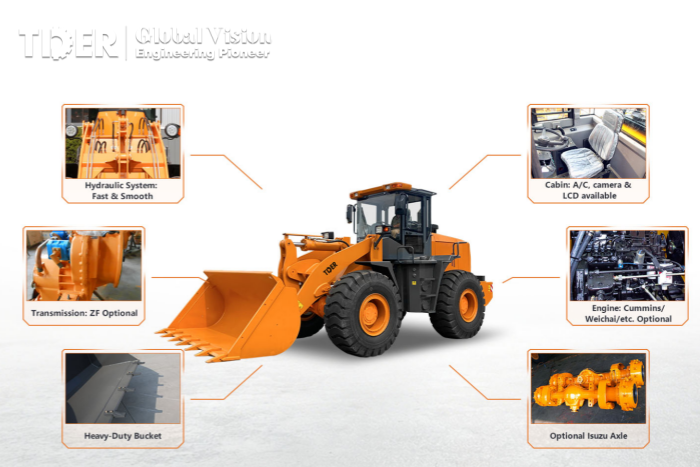
The ZT920 Wheel Loader features a 1.2 m³ bucket and a 2,000 kg rated load, making it suitable for loading and transporting loose materials between stockpiles and processing areas. Its 58 kW engine supports regular material-handling operations.
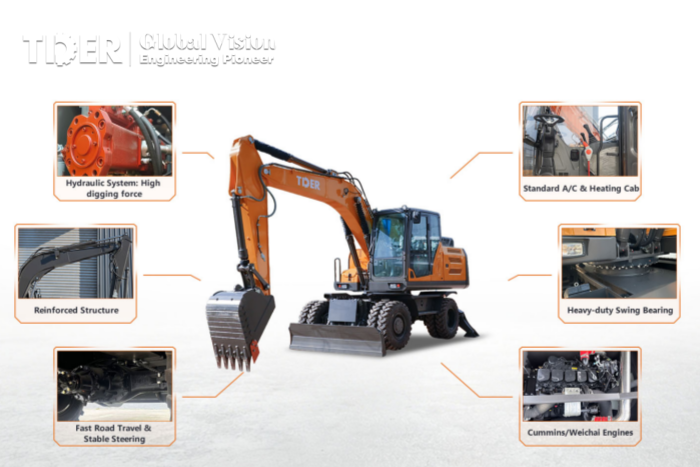
The TCE210 Crawler Excavator features a 1.0 m³ bucket, 129 kW engine, and 6,480 mm maximum digging depth. Its boom-and-arm configuration provides a wider working range for excavation and material handling, particularly when raw materials need to be extracted before crushing.
These specifications illustrate the different design priorities of the two machines. The wheel loader focuses on loading efficiency, while the excavator prioritizes digging capability and working reach. The right choice ultimately depends on the material, crusher requirements, and site conditions.
7.Hydraulic Breaker vs. Bucket: Which Excavator Attachment Is Better for Rock Breaking?
When preparing oversized rocks for a crusher, choosing the right excavator attachment can directly affect feeding efficiency and material handling. An excavator bucket is designed for digging, loading, and moving materials, while a hydraulic breaker is specifically used to break hard rock and oversized materials into smaller, more manageable pieces. Understanding their different functions helps operators select the right Rock Breaking Equipment for each stage of the crushing process.
What Is a Hydraulic Breaker?
A hydraulic breaker is an excavator attachment powered by the machine’s hydraulic system. It converts hydraulic energy into repeated mechanical impacts through a piston and chisel, breaking hard materials into smaller pieces. It is commonly used for hard rock, concrete, and oversized boulders.
In crusher-feeding operations, a hydraulic breaker helps pre-process rocks that exceed the crusher’s maximum feed size, reducing blockages and making subsequent material handling more efficient.
Excavator with Hydraulic Breaker for Oversized Rocks
An Excavator with Hydraulic Breaker is particularly useful when large rocks cannot enter the crusher directly. The breaker can reduce oversized materials at the quarry or mining site before they are moved to the crusher.
This process helps minimize interruptions caused by oversized rocks and creates more consistent feed material. It is suitable for quarrying, mining, and construction demolition projects where hard or irregular materials require preliminary breaking.
Hydraulic Breaker vs. Wheel Loader Bucket
A wheel loader bucket and a hydraulic breaker serve different purposes rather than directly replacing each other.
|
Comparison |
Wheel Loader Bucket |
Hydraulic Breaker |
|
Main function |
Loading and transporting materials |
Breaking hard materials |
|
Suitable materials |
Loose soil, gravel, aggregates |
Hard rock, concrete, oversized boulders |
|
Role in crusher feeding |
Transfers material into the crusher |
Prepares oversized material before feeding |
|
Main advantage |
Efficient bulk material handling |
Reduces oversized materials |
A wheel loader is generally more efficient for transporting and feeding loose materials, while an excavator equipped with a hydraulic breaker is better suited to rock breaking and pre-processing oversized materials. In many operations, both machines work together to improve the overall crushing workflow.
How to Select Rock Breaking Equipment
When selecting an Excavator for Rock Breaking, consider the following factors:
Rock hardness and size: Harder and larger rocks require greater breaking capability.
Excavator operating weight: The machine must provide sufficient stability and support for the attachment.
Hydraulic system compatibility: Check the required oil flow and operating pressure against the excavator's specifications.
Breaker performance: Compare impact energy and impact frequency according to the material and working conditions.
Operating costs: Consider fuel consumption, attachment wear, maintenance, and breaking efficiency.
The key is to match the excavator and hydraulic breaker to the actual rock conditions and the crusher’s feed requirements, rather than selecting an attachment based on impact power alone.
8.Wheel Loader or Excavator? Choosing the Right Equipment for Different Scenarios
The right crusher-feeding equipment depends on the material being processed and the working environment.
Large Aggregate Stockpiles: For large stockpiles of loose aggregates, gravel, and crushed stone, a wheel loader is generally the preferred choice. Its large bucket capacity and fast loading cycles make it efficient for short-distance material transportation and continuous crusher feeding.
Hard Rock Quarries: When materials come directly from rock formations, an excavator is more suitable for digging and handling irregular or oversized rocks. A hydraulic breaker can be added to break large rocks into manageable sizes before crushing.
Mobile Crusher Operations: For mobile crushing plants, equipment selection depends on available working space, material distribution, and feeding positions. Excavators offer flexibility in confined or uneven areas, while wheel loaders work well when sufficient maneuvering space is available.
Mixed Material and Continuous Production: When excavation, rock breaking, and material transportation are required simultaneously, using both machines can improve workflow efficiency. The excavator handles digging and oversized materials, while the wheel loader transports and feeds loose materials into the crusher.
9.Practical Example: Matching TDER Machinery to Crusher Feeding Applications
Selecting the right equipment depends on material characteristics, jobsite conditions, and crusher capacity. For bulk aggregate handling, the TDER ZT950EV 5-ton wheel loader features a 3 m³ bucket, 5,000 kg rated load, and 9.7-second total cycle time, supporting efficient material loading and transportation.
For excavation and oversized rock handling, the TDER 21-ton crawler excavator delivers 129 kW of engine power, a 21,000 kg operating weight, and a maximum digging depth of 6,480 mm. It can also be configured with compatible hydraulic attachments for demanding applications. By matching machine capacity, bucket size, and attachment configuration to actual operating conditions, operators can build a more efficient crusher-feeding solution.
10.How to Improve Crusher Feeding Efficiency
Improving crusher feeding efficiency requires proper material management and equipment coordination.
Maintain a Consistent Feed Rate: Keep material flowing steadily into the crusher to avoid overloading, idle time, and production interruptions.
Prepare Material Before Feeding: Remove foreign objects and break oversized rocks using suitable equipment, such as an excavator equipped with a hydraulic breaker. Ensure material size meets the crusher's feed opening requirements.
Match Machine Capacity to Crusher Output: Select a wheel loader or excavator with suitable bucket capacity and operating performance. Minimize unnecessary loading cycles, waiting time, and travel distances to improve overall productivity and reduce operating costs.
11.Frequently Asked Questions
Is an Excavator or Wheel Loader Better for Feeding a Crusher?
A wheel loader is generally better for handling and transporting large volumes of loose materials, while an excavator is more suitable for digging, handling oversized rocks, and precise feeding. The best choice depends on material conditions and jobsite requirements.
Can a Wheel Loader Break Large Rocks?
A standard wheel loader is designed primarily for loading and material transportation, not rock breaking. For oversized rocks, an excavator equipped with a hydraulic breaker is a more suitable solution.
When Should You Use an Excavator with a Hydraulic Breaker?
An excavator with a hydraulic breaker is ideal when handling hard rock, oversized stones, or materials that exceed the crusher's maximum feed size. It breaks large materials into smaller pieces before they enter the crushing system.
Can Wheel Loaders and Excavators Work Together in a Quarry?
Yes. Excavators can handle excavation and oversized rock breaking, while wheel loaders transport loose materials and feed the crusher. Using both machines can improve material handling efficiency and support continuous production.
12.Conclusion: Wheel Loader vs. Excavator — Which Is the Best Crusher Feeder?
Choosing between a wheel loader and an excavator depends on your material handling and crushing requirements. Wheel loaders excel at loading large volumes of loose materials and transporting them efficiently, while excavators are better suited for excavation, precise feeding, and handling oversized rocks in challenging conditions. For hard rock applications, an excavator equipped with a hydraulic breaker provides an effective solution for breaking oversized materials before crushing. Ultimately, consider material characteristics, jobsite conditions, production targets, and operating costs when selecting equipment. Contact TDER Machinery to explore suitable wheel loader and excavator solutions for your crushing operations.